
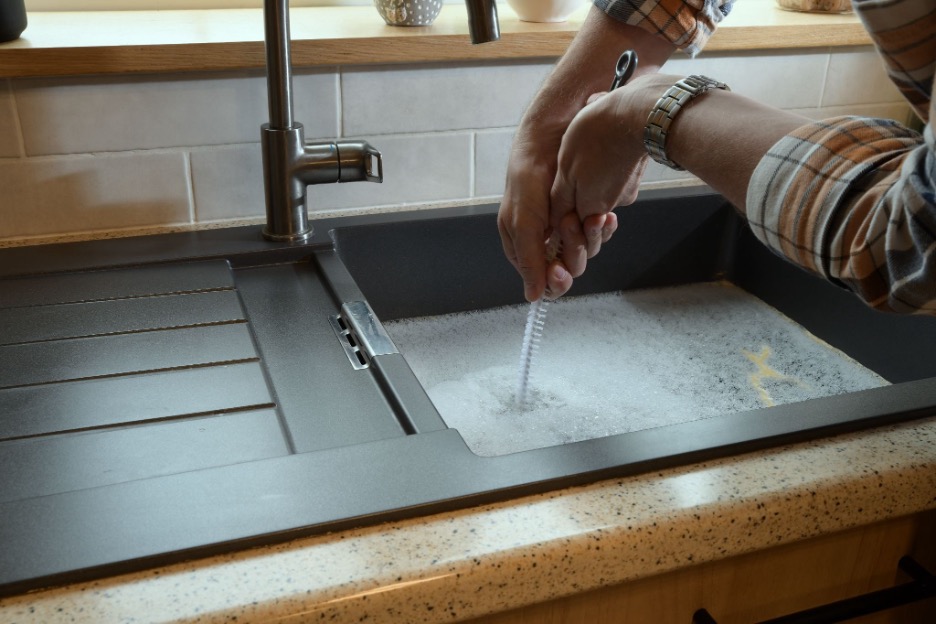
A drain that clogs once is a nuisance. A drain that clogs every few weeks is trying to tell you something.
Most homeowners reach for the plunger, get things moving again, and figure the problem is solved. But if the same drain keeps backing up, or if clogs seem to be spreading to other fixtures in the house, the plunger isn’t fixing anything. It’s just buying time.
Recurring drain clogs almost always have an underlying cause. Here’s what’s most likely behind them, and what it takes to actually resolve the problem.
The Clog Keeps Coming Back Because the Clog Was Never Fully Cleared
This is the most common situation, and it’s worth saying plainly. A plunger moves the blockage. It doesn’t remove it. If a clog in your kitchen sink is caused by grease coating the pipe walls, plunging shifts the immediate blockage but leaves the buildup behind. The next load of dishes washes more grease onto the same stretch of pipe, and within a few weeks, you’re back where you started.
The same logic applies to hair in a bathroom drain. Pulling out what you can reach with a drain snake gets the visible mass, but the residue clings to the pipe and starts catching new debris almost immediately.
What to do: If a clog returns within a few weeks of clearing it, the pipe needs to be cleaned, not just opened. A professional drain cleaning removes the buildup along the pipe walls, not just the blockage at the narrowest point.
Your Pipes Have Mineral Buildup from Hard Water
Austin has hard water. The water here carries high concentrations of calcium and magnesium, and those minerals deposit on the interior walls of your pipes, leaving white residue on your showerhead and coffee maker.
Over time, mineral scale narrows the pipe. Water slows down. Debris that would have washed through in a larger pipe starts to catch and accumulate instead. The result looks like a grease clog or a hair clog, but the underlying problem is the pipe’s reduced diameter. Clearing the clog doesn’t solve the scale.
This is particularly common in older homes, where decades of mineral buildup have significantly reduced pipe capacity.
What to do: If you have recurring clogs across multiple fixtures and your home is more than 20 or 30 years old, ask a plumber about descaling or hydro-jetting. High-pressure water cleaning removes mineral scale along the full length of the pipe, not just at the blockage.
Grease Has Been Going Down the Kitchen Drain
This one is worth being direct about. Grease and cooking oil look like liquids when they’re hot, but they behave like solids once they cool inside your pipes. Every time grease goes down the kitchen drain, it coats the interior walls. Over weeks and months, that layer thickens. It starts trapping food particles. Eventually, the pipe narrows enough to clog, and no amount of hot water flushes the buildup out.
Dish soap helps, but it doesn’t fully cut grease once it’s solidified on pipe walls. “Grease-cutting” dish soap is designed for dishes, not plumbing systems.
What to do: Wipe cookware with a paper towel before washing and dispose of cooking oil in a container rather than the sink. If your kitchen drain is already slow, the buildup is already there, and it needs to be physically removed. Chemical drain cleaners won’t do it and can damage older pipes in the process.
Hair and Soap Scum Are Building Up Faster Than You Think
Most bathroom drain clogs come down to two things: hair and soap. Hair catches on any roughness in the drain or pipe, accumulates in a mass, and starts trapping everything else. Soap scum binds it all together and hardens over time. A drain that seems fine on Monday can be noticeably slow by Friday if a partial blockage is already developing below the drain cover.
If multiple people in the house use the same bathroom, the buildup rate accelerates proportionally.
What to do: Drain covers and hair catchers reduce how much hair enters the pipe in the first place, and they’re worth using consistently. But if the drain is already slow, clearing the visible accumulation near the surface often isn’t enough. The buildup usually extends further into the pipe than it looks.
Your Main Sewer Line Has a Problem
If clogs are happening in multiple fixtures at the same time, the problem isn’t in the individual drains. It’s in the main line.
Your home’s individual drain lines all feed into a single main sewer line that carries waste out to the street. When that line is partially blocked, restricted, or damaged, the symptoms show up throughout the house. Toilets flush slowly. The bathtub backs up when you run the washing machine. Water comes up in one fixture when you use another. These are signs that something is wrong further down the system, past where any individual drain fix will help.
In Austin, two causes are especially common. Tree roots from live oaks and other established trees find their way into sewer lines through tiny cracks and joint gaps, then expand to create a partial or complete blockage. And because much of Austin is built on expansive clay soil that shifts with the seasons, pipe joints in older systems sometimes separate or sag, creating low spots where debris accumulates.
What to do: Mainline problems require camera inspection. A plumber runs a small camera through the line to see exactly what’s causing the obstruction and where. Guessing at a main line problem leads to repeated clearing that doesn’t fix anything. The camera removes the guesswork.
Your Pipes Are Old Enough That the Problem Is Structural
Homes built before the 1980s in Austin often have galvanized steel or cast iron drain pipes. Both materials corrode over time. Galvanized steel rusts from the inside out, creating a rough interior surface that catches debris and narrows the pipe diameter. Cast iron can crack, shift, and develop low spots where waste pools instead of moving through.
In these systems, clogs aren’t a behavior problem. They’re a structural one. The pipes are degraded enough that they clog under normal, everyday use. Clearing them provides temporary relief, but the underlying condition doesn’t improve.
What to do: If your home is older and you’re dealing with persistent drain problems throughout the house, it’s worth having a plumber assess the condition of the pipes. In some cases, targeted repairs or relined sections solve the problem. In others, repipe is the more practical long-term answer.
What Do You Do If Your Drains Keep Clogging?
If any of this sounds familiar, it’s time to move past the plunger.
Clarke Kent Plumbing has been clearing drains and diagnosing plumbing problems in Austin homes since 1986. We use camera inspection and professional drain cleaning equipment to find what’s actually causing recurring clogs, explain what we’re seeing, and give you options based on what the pipe actually needs. Not every slow drain requires a major repair. But the ones that keep coming back usually need more than a quick clear.
A drain that clogs once might just be a drain. A drain that keeps clogging is a plumbing system asking for attention.
For plumbing emergencies, call us at 512-477-2200. We answer live 24 hours a day, 7 days a week.
Frequently Asked Questions
Why does my drain keep clogging after I clear it?
Because clearing a clog and cleaning a pipe are two different jobs. A plunger or a hand snake moves the blockage out of the way, but the grease, hair, or mineral scale coating the pipe walls stays behind and starts catching debris again within days. If a drain backs up again within a few weeks of being cleared, the pipe itself needs to be cleaned along its full length.
How often is too often for a drain to clog?
More than once or twice a year in the same fixture points to an underlying cause. A single clog after a holiday meal or a heavy shedding season is normal household use. A drain that backs up every few weeks, or clogs that start appearing in fixtures that never gave you trouble before, indicate buildup, reduced pipe diameter, or a problem in the main line.
Are chemical drain cleaners safe to use on a recurring clog?
They will not solve a recurring clog, and they can create a second problem. Caustic drain cleaners are formulated to dissolve a soft blockage near the drain opening, so they have little effect on hardened grease or mineral scale further down the pipe. In galvanized steel and older cast iron systems common in Austin homes built before the 1980s, repeated chemical use accelerates corrosion.
What is hydro-jetting, and do I need it?
Hydro-jetting uses pressurized water to scour the interior walls of a drain line, removing grease, scale, and soft root intrusion rather than punching a hole through the blockage. It is the right tool when clogs recur across multiple fixtures, when a home is 20 to 30 years old or more, or when a camera inspection shows buildup along a long stretch of pipe. It is unnecessary for a one-time clog in an otherwise healthy line.
How do I know if the problem is my main sewer line?
Watch for symptoms that appear in more than one fixture at the same time. A toilet that flushes slowly while the tub gurgles, water rising in one drain when you run another, or a bathtub that backs up during a washing machine cycle all point past the individual drains to the line carrying waste out to the street. In Austin, tree root intrusion and shifting clay soil are the two most frequent causes.
Does Austin’s hard water cause clogged drains?
Indirectly, yes. Austin water carries high concentrations of calcium and magnesium, and those minerals deposit as scale on the interior walls of supply and drain lines over years of use. The scale narrows the pipe, slows the flow, and lets debris catch and accumulate where it would have washed through a clean line. The visible symptom looks like a hair or grease clog, though the cause is the reduced diameter underneath it.
When should I call a plumber instead of clearing it myself?
Call when the same drain clogs twice, when more than one fixture is affected, or when you see any sewage backup. Those three situations point to a cause you cannot reach from the drain opening, and repeated home clearing tends to postpone the diagnosis while the underlying condition gets worse. Clarke Kent Plumbing has diagnosed drain problems in Austin homes since 1986 and answers live 24 hours a day at 512-477-2200.
Frequently Asked Questions
How Do I Verify a Texas Plumbing License?
The Texas State Board of Plumbing Examiners maintains a public license search on its website, and you can look up a plumber by license number, individual name, or company name. The record shows the license level, its status, and whether it is current. Run the search before work begins rather than after, and confirm the name on the license matches the company sending a technician to your property.
Should I Get More Than One Estimate?
For scheduled work like a repipe, a water heater replacement, or a sewer line repair, two or three estimates give you a sense of the fair range in your area. For an active leak or a sewage backup, the delay usually costs more than the comparison saves. Be cautious when one bid comes in far below the others, since the gap often reflects a narrower scope, cheaper materials, or work performed without a permit.
What Should a Written Estimate Include?
A useful estimate names the specific repair, the parts and materials involved, the labor charge, any permit or inspection fees, and the conditions under which the price could change once a wall or slab is opened. Ask whether the diagnostic or trip fee applies toward the repair if you approve the work. Verbal quotes leave both sides guessing, so get the scope in writing even on smaller jobs.
Do Plumbers Guarantee Their Work?
Reputable companies stand behind their labor, though the terms vary widely and parts are frequently covered separately under the manufacturer’s warranty. Ask how long the labor guarantee runs, what voids it, and whether a callback for the same issue carries a charge. Get the answer before the work starts, since a guarantee described after the fact is difficult to hold anyone to.
Do I Need a Permit for Plumbing Work in Austin?
Many projects do, including water heater replacements, repipes, sewer and gas line work, and adding or relocating fixtures. Routine repairs such as clearing a drain or swapping a faucet generally do not. A licensed plumber pulls the permit and schedules the city inspection as part of the job, and unpermitted work on a system like a gas line can surface later as a problem during a home sale or an insurance claim.
Can a Handyman Handle Plumbing Work Instead of a Licensed Plumber?
Texas restricts plumbing work to licensed plumbers, with narrow exceptions for homeowners working on their own residence. Handyman labor on a supply line, a drain line, a water heater, or anything connected to gas falls outside that allowance, and the resulting work is both uninspected and outside the scope of most homeowner policies. The savings tend to disappear the first time the repair fails behind a wall.
How Can We Help?
For any inquiries or questions, please call us at 512-477-2200 or email us at dispatch@clarkekentplumbing.com



1408 W. Ben White Blvd.
Austin TX 78704
Phone: 512-477-2200
Fax: 512-916-8856
dispatch@clarkekentplumbing.com
This email is monitored Mon-Fri 7:30am-5:00pm





#14195
© 2026 Clarke Kent Plumbing, Inc.